
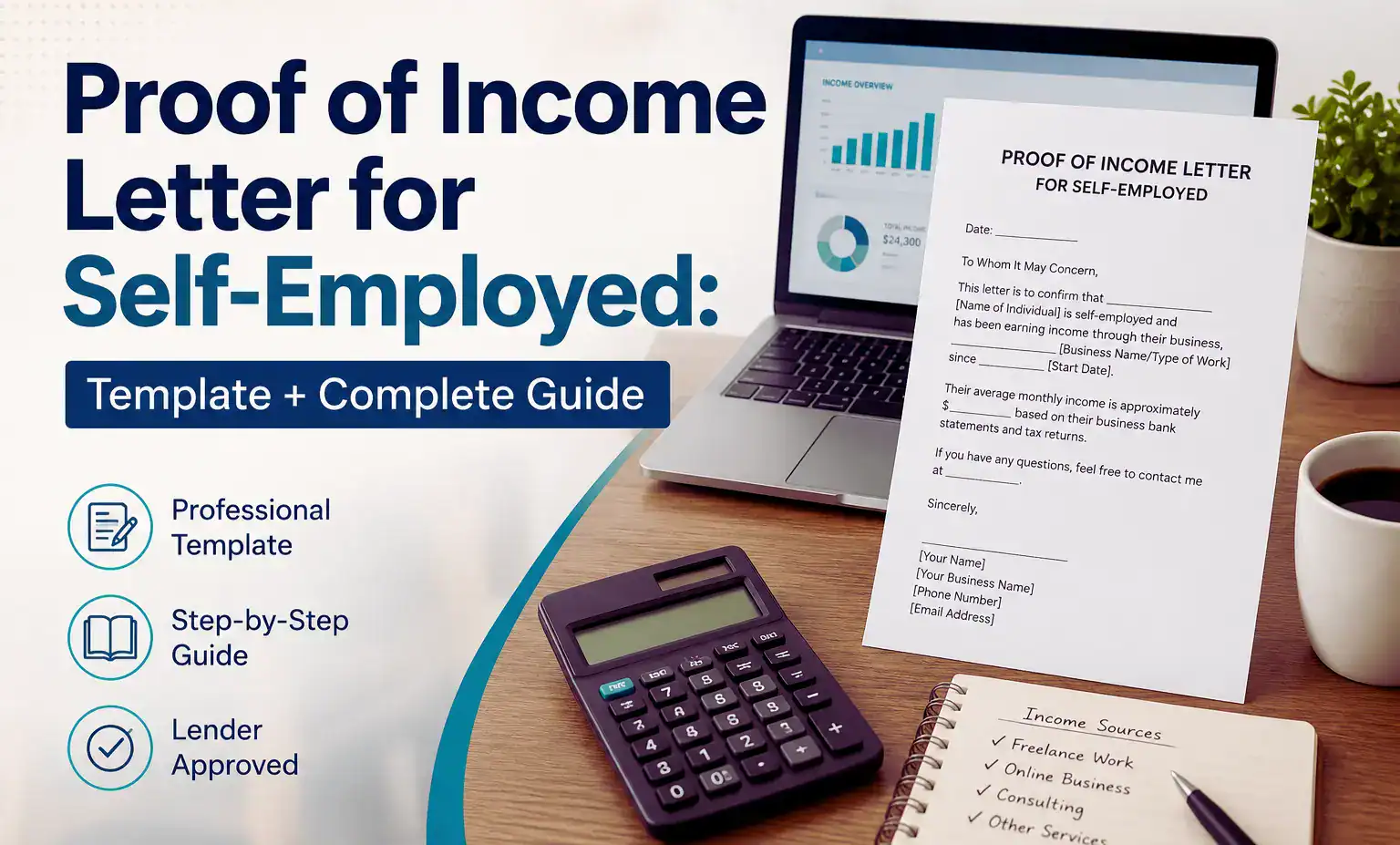
Landlord asked for something you don’t have, a boss, an HR department, a payroll system? Here’s the fix: a proof of income letter for self-employed applicants is a short, signed statement that summarizes your income, your business, and how long you’ve been working for yourself. Below you’ll find a ready-to-use self employed income letter template, a full breakdown of what belongs in it, and the exact steps to fill it out so it actually holds up when someone checks it.
Why This One Page Matters More Than People Think
Being self-employed comes with a strange side effect, you can be doing great financially and still feel like you’re on the back foot the moment a landlord says “just send over your proof of income.” There’s no HR department to email. No payroll portal to log into. Just you, your bank account, and a folder of invoices that don’t look like anything a rental application usually expects.
This is exactly where a proof of income letter earns its place. It doesn’t replace your bank statements or your tax return, it sits in front of them, translating your income into something a landlord can read in ten seconds instead of piecing it together themselves from raw numbers. Think of it as the cover page for your entire application.
We’ve written about the fuller picture of self-employed proof of income documents elsewhere, and if you’re freelancing specifically rather than running a broader business, our guide on proving income as a freelancer for an apartment walks through the same idea from a slightly different angle. This guide zooms in on the letter itself, because that one page tends to be the part people get stuck on.
What Actually Belongs in a Self-Employed Proof of Income Letter
A good income verification letter for a freelancer or self-employed applicant isn’t long. It’s specific. Here’s what a landlord or lender actually wants to see in it:
- Your full name and business name. If you operate under a business name, include it, it ties the letter directly to a real, identifiable person or entity, not a vague description of “freelance work.”
- What you actually do. One or two sentences is plenty. “Independent UX designer working with SaaS companies” tells a landlord far more than “self-employed.”
- How long you’ve been self-employed. A landlord reading a proof of income letter is quietly asking one question: is this stable? Time in business is the fastest way to answer that.
- Your average monthly or annual income, with a clear time period. This is the core of the letter, and it’s also where a self employed income letter template can go wrong if the numbers aren’t tied to a specific window, always say “based on the last 12 months” or “based on 2025 tax filings,” not just a bare number.
- Contact information. A phone number and email signal that the letter can actually be verified, not just taken on faith.
- A signature and date. Even a self-written letter carries more weight signed than unsigned.
- A mention of attached documents. Bank statements, a tax return, or 1099 forms referenced directly in the letter turn it from a claim into something backed by evidence.
How to Structure Your Self-Employed Proof of Income Letter
Once you have the seven elements above ready, the letter itself follows a simple, predictable structure: your contact details at the top, the date, a short opening line stating the letter’s purpose, a paragraph describing your work and how long you’ve been self-employed, a paragraph with your income figures and the time period they cover, a line referencing your attached supporting documents, and a signed closing.
Getting the structure right matters more than making it sound impressive. A landlord or lender is scanning for specific facts, not reading for style, so the clearer and more direct each section is, the faster your letter does its job.
A word of advice: keep the language plain and resist the urge to round your income up. Whatever figure goes into this proof of income letter for self-employed applicants needs to match your bank statements and tax return exactly, any gap between the letter and the paperwork behind it raises more questions than the letter was ever meant to answer.
If you’d rather not draft this from scratch, or want to be sure every line is worded the way landlords and lenders expect, our proof of income page puts together an accurate, ready-to-send letter using your real numbers, so you’re not guessing at the wording yourself.
Step-by-Step: Writing and Using Your Income Letter
- Look at your real numbers before you write anything. Pull up your bank statements or a simple profit and loss summary from the last 6-12 months. Your letter should reflect what’s actually there, not an estimate you’re hoping is close.
- Draft the letter using the structure above. Work through each section in order, your details, your business, your income figures, and your supporting documents, filling in your actual name, business type, timeframe, and numbers as you go.
- Keep your job description short and specific. You’re not writing a business plan, one clear sentence about what you do is enough.
- Attach your supporting documents. A couple months of bank statements, your latest tax return, or relevant 1099 forms should travel with the letter, not sit somewhere else in your application.
- Sign it and date it. It sounds small, but an unsigned letter reads like a draft, not a document.
- Get it notarized if the stakes are higher. For a mortgage or a larger financial application, notarizing the letter adds a layer of legitimacy. For a standard apartment rental, it’s usually not necessary.
- Send it alongside your other proof of income documents, never as the only thing in your application. On its own, a letter is a claim. Paired with real records, it becomes proof.
Where People Go Wrong With This Letter
They round the numbers up. It’s tempting to nudge income a little higher when writing it yourself, but the letter has to match your actual bank statements and tax filings. As we’ve covered in our piece on why fake income documents get caught in 2026, inflated numbers create real legal exposure, not just a slightly awkward conversation with a landlord.
They leave out the timeframe. “I make $60,000 a year” means very little without a window attached to it. Always anchor the number to a specific period, the last 12 months, the most recent tax year, whatever applies.
They send the letter with nothing behind it. A letter by itself is just a statement from you, about you. Bank statements, a tax return, or 1099s are what actually make it believable.
They skip the contact details. Some landlords or screening services genuinely do call to confirm. A missing phone number or email makes an otherwise solid letter look incomplete.
They stay too vague about the work itself. “I do freelance stuff” doesn’t tell anyone anything. Naming your field and who you typically work with does a lot of quiet, unglamorous work toward being believed.
When You’ll Actually Need This Letter
A proof of income letter tends to show up in a fairly predictable set of situations, and it helps to know when to have one ready.
Rental applications. This is where it comes up most. Landlords often want it sitting alongside bank statements or a tax return, especially when your income doesn’t fit neatly into one document.
Loan or mortgage applications. Lenders sometimes ask for a letter to go with Schedule C or 1099 forms, particularly if your income has grown recently and last year’s tax return doesn’t fully capture where things stand now.
Co-signer situations. If someone is co-signing for you, a clear letter helps them, and the landlord, understand your finances without wading through raw bank data themselves.
Visa, immigration, or benefits applications. Some of these processes ask for a self-employment income letter as part of a broader financial documentation package, often alongside notarized tax returns.
In every one of these, the letter is doing the same job: turning scattered numbers into one page someone can actually read and trust.
Need help putting together a proof of income letter that actually holds up? Our proof of income template walks you through creating a legitimate, accurate letter and pay stub, built for self-employed people, freelancers, and independent contractors, and fully compliant with 2026 standards.
Comparison Table: Proof of Income Letter vs. Other Documents
| Document | Best Used As | Preparation Time | Notes |
| Proof of income letter | Summary alongside other documents | Same day | Should never be submitted alone |
| Bank statements | Primary proof of cash flow | Immediate | Strongest standalone document |
| Tax return + Schedule C | Long-term income history | 1-2 weeks if not on file | Best for 1+ year of history |
| 1099 forms | Client-reported income | Immediate if received | Adds third-party verification |
| Profit and loss statement | Detailed income vs. expense view | 1-3 days | Pairs well with the letter |
Frequently Asked Questions
What should a proof of income letter include for self-employed individuals?
A self-employed proof of income letter should include your full name and business name, a brief description of your work, how long you’ve been self-employed, your average monthly or annual income with the time period it covers, contact information, and a signature. It should also reference any attached supporting documents.
Is a self-employed income letter enough on its own for a rental application?
Usually not by itself. Most landlords expect the letter to be paired with supporting documents like bank statements, a tax return, or 1099 forms. The letter works best as a clear summary that ties the rest of your documentation together, not as a standalone proof of income.
Can I write my own proof of income letter as a self-employed person?
Yes. Self-employed individuals routinely write their own income letters, since there’s no employer to issue one on their behalf. The key is making sure every figure in the letter accurately matches your actual bank statements, tax returns, or other financial records.
Does a proof of income letter need to be notarized?
Not usually for standard apartment applications, though notarizing it can add credibility for larger applications like mortgages. Check with the specific landlord or lender, since requirements vary depending on the size and type of the application.
How do I calculate my average income for the letter?
Add up your total income over the period you’re referencing, typically the last 6 to 12 months, or your most recent tax year, and divide it by the number of months to get an average monthly figure. Base this on your actual bank deposits or tax return rather than an estimate.
What documents should I attach to a proof of income letter?
Common attachments include 2-3 months of bank statements, your most recent tax return with Schedule C, and any 1099 forms you’ve received. Attaching at least one of these turns the letter from a simple claim into a verifiable piece of your application.
Conclusion
A proof of income letter won’t do the whole job on its own, but it’s often the piece that makes everything else in a self-employed application easier to trust. It gives a landlord a quick, honest summary of who you are and what you earn before they ever get to your bank statements or tax return.
Follow the structure above, use your real numbers, sign it, and attach the paperwork that backs it up. If you’d rather have it done right the first time, worded correctly, backed by accurate figures, and ready to send, our proof of income can put together your letter and supporting pay stub in minutes.






Add comment