
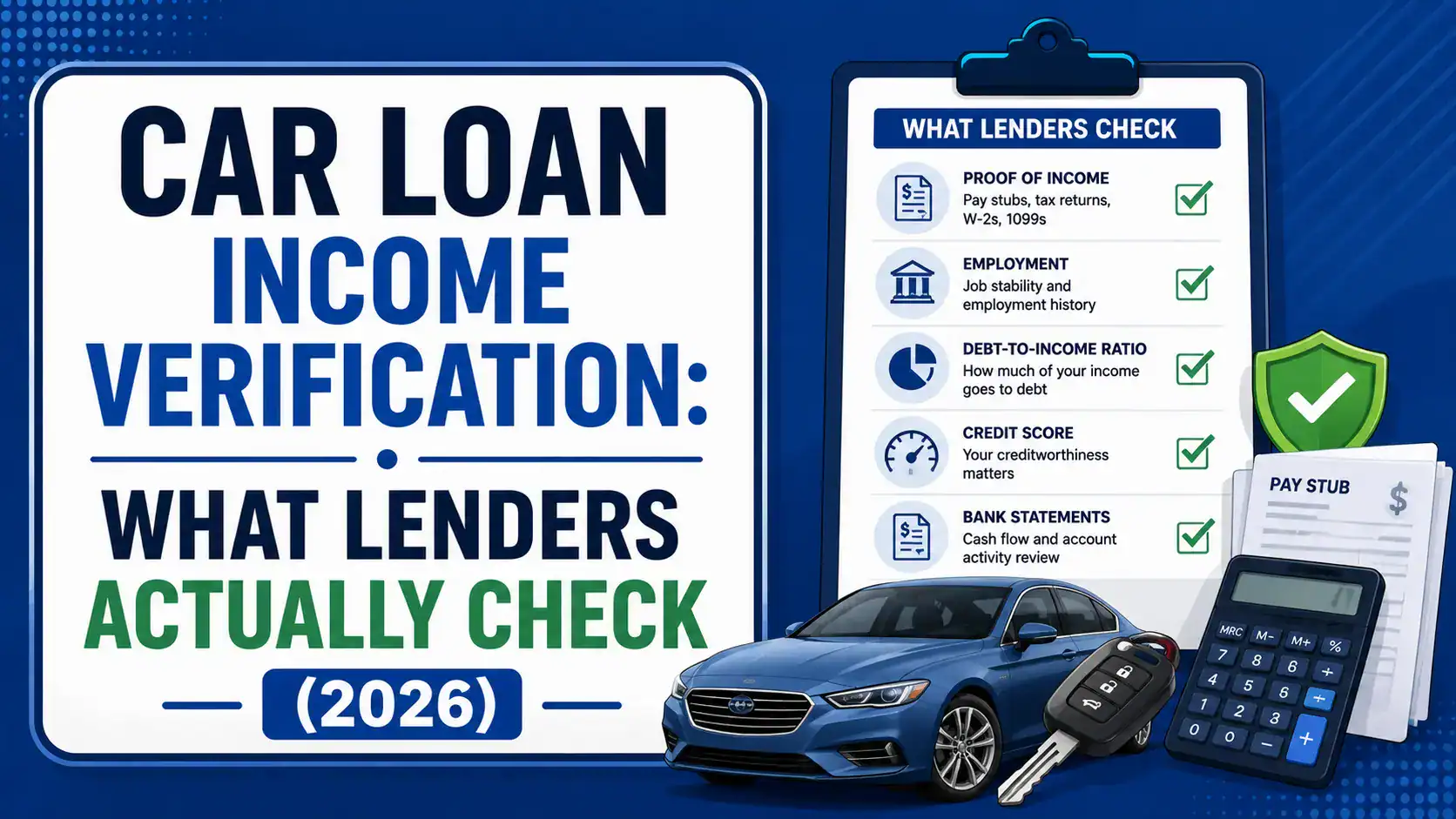
What does car loan income verification actually involve? Lenders check your income through pay stubs, tax returns, bank statements, and sometimes a direct call to your employer, then use that income to calculate your debt-to-income and payment-to-income ratios. How closely they verify depends on your credit score, your down payment, and how expensive the car is, strong credit and a solid down payment can sometimes mean lighter verification, while weaker credit usually means full documentation and an employer call.
Why Car Loan Income Verification Feels More Invasive Than It Needs To
Walking into a dealership, or filling out an online auto loan application, and then getting asked for pay stubs, tax returns, and permission to call your employer can feel like a lot for what’s supposed to be a straightforward purchase. You hand over a stack of personal financial documents to a total stranger, and somewhere in the back of your mind a little voice asks: is something about my application looking shaky? Did I do something wrong?
Probably not. Here’s the more reassuring way to think about it: car loan income verification isn’t personal, and it isn’t a sign of suspicion. It’s a standard risk calculation that every lender runs on every single applicant, rich or not-so-rich, perfect credit or recovering credit. Once you understand what they’re actually looking at, and why, the whole process stops feeling like a mystery and starts feeling like a checklist you can just get through.
This guide breaks down exactly what car loan income verification involves, how the process differs depending on how you earn your money, how your credit score changes the level of scrutiny, and what to do if something doesn’t line up as cleanly as you’d like.
The 3 Numbers Every Lender Is Actually Calculating
Underneath all the paperwork, a lender doing car loan income verification is really just trying to answer three quiet questions, and your income feeds directly into two of them.
Debt-to-Income (DTI) ratio. This compares your total monthly debt payments, including the new car payment you’re about to take on, against your gross monthly income. Most auto lenders like this to stay under roughly 36%, though the exact cutoff shifts depending on the lender and your credit tier.
Payment-to-Income (PTI) ratio. This one’s more specific to auto lending. Instead of looking at all your debt, it isolates just the new car payment against your gross monthly income. Prime lenders, the ones handing out the best rates, often want PTI under 15%. Near-prime lenders will sometimes stretch to 18-20%. Subprime lenders, who are taking on more risk by definition, may go as high as 20-22%.
Loan-to-Value (LTV) ratio. This one compares the size of the loan to what the car is actually worth. A bigger down payment brings your LTV down, which lowers the lender’s risk if things ever went sideways, and it can genuinely make up for a slightly thinner income file.
Every document a lender asks you for during car loan income verification exists to feed one of these three numbers. Without a verified income figure, DTI and PTI simply can’t be calculated at all, which is really the whole reason this process exists in the first place.
How Car Loan Income Verification Works, Broken Down by Income Type
The documents a lender asks for depend heavily on how you actually earn your money, and it’s worth knowing your category before you even start the application.
W-2 employees. This is the easiest case, and if this is you, car loan income verification usually moves fast. Lenders typically ask for your 2-3 most recent pay stubs, and sometimes your most recent W-2 on top of that. A lot of lenders these days verify this instantly through automated employment databases like The Work Number, Truework, or Experian Verify, which pull your employment and income data straight from payroll systems, sometimes so quickly you barely notice it happened. It’s worth making sure your pay stubs are clean, accurate, and free of formatting mistakes before handing them over, since lenders (much like landlords) are increasingly running the same kind of scrutiny over them. Our guide on red flags landlords and lenders check on a pay stub walks through exactly what tends to get flagged.
Self-employed borrowers. This category involves more paperwork and more patience. Lenders generally want 1-2 years of tax returns with Schedule C, plus 2-3 months of recent bank statements, and because this all requires manual review rather than an automated database pull, it simply takes longer. If this is your situation, getting pre-approved before you ever set foot in a dealership makes a real difference, our full breakdown on proof of income for a car loan when self-employed goes much deeper into exactly what to prepare and how much income history lenders actually expect to see.
Retired applicants. Retirees typically lean on Social Security statements, pension documentation, or a 1099-R showing retirement account distributions instead of pay stubs. One thing worth knowing here: a 1099-R can sometimes show a surprisingly large “distribution” even for something as routine as an account rollover, and that number isn’t a red flag on a loan application any more than it’s a tax problem. If that number has ever confused you, our plain-English explainer on what a 1099-R form actually means breaks down exactly what those codes and figures represent.
Unemployed or non-traditional income applicants. This is the toughest category, mostly because there’s no single standard document to point to. Lenders may look at savings, investment income, or ask for a co-signer with verifiable income to offset the added risk they’re taking on by lending to you.
Does Your Credit Score Change How Closely They Check?
Yes, and the relationship is pretty predictable once you see it laid out.
- Excellent credit (generally 720+): Some lenders will genuinely relax income verification if your credit history and down payment already look strong, since those two factors alone are doing a lot of the risk-reduction work.
- Good to fair credit: Standard documentation applies here, your recent pay stubs or tax returns, plus a look at your bank statements.
- Poor credit (roughly below 580): Expect the full treatment, complete documentation and, quite often, a direct call to your employer, since subprime lenders are taking on meaningfully more risk and want to see it confirmed from every angle.
Does the Price of the Car Actually Matter Here?
It really does. More expensive vehicles trigger more thorough car loan income verification almost automatically, regardless of how good your credit score looks on paper. Anything priced above roughly $50,000 tends to get the full documentation treatment, simply because the lender has more money on the line. Cheaper or used vehicles, on the other hand, tend to come with noticeably more flexible verification standards, especially at credit unions, which often care more about your overall financial picture than about checking every box perfectly.
What Actually Happens During an Employer Verification Call
If a lender calls your workplace, it’s typically a short, almost forgettable call, confirming your job title, your employment status, maybe your salary range. It’s not a deep dive into your performance reviews or your five-year plan. Still, it’s worth giving your employer or HR department a quick heads-up that a call might come through, mostly so it doesn’t catch a coworker off guard when the phone rings. A lot of larger employers have automated this entirely now, routing these calls through an employment verification database instead of a live person, which speeds everything up considerably. These same automated systems increasingly do double duty, catching inconsistencies in submitted documents too, which is worth keeping in mind no matter how confident you feel about your paperwork.
What If Your Documents Don’t Line Up Cleanly?
Sometimes a pay stub, tax return, or bank statement doesn’t quite match what a lender expects, and it’s rarely as alarming as it feels in the moment.
Gross vs. net income confusion. Lenders calculate DTI and PTI using your gross income, not your take-home pay, so don’t panic if the number they’re using looks bigger than what you’re used to seeing land in your account.
Recent job changes. If you started a new job recently, some lenders will want an offer letter or a short explanation of your employment history, since a brand-new job can look like instability on paper even when your actual income is completely solid.
Self-employed income gaps. If your net income, after business expenses, looks lower than your total revenue, a profit and loss statement or a short written explanation can go a long way toward clearing up the picture for an underwriter.
Multiple income sources. If you’re juggling more than one job, or mixing gig income with a traditional paycheck, bring documentation for every source rather than just your main one, combined income can genuinely improve your DTI and PTI numbers.
How to Prepare Before You Apply
A little bit of preparation before you sit down with a lender, or click “apply” online, can meaningfully speed up the entire car loan income verification process.
- Gather your most recent 2-3 pay stubs, or 1-2 years of tax returns if you’re self-employed, before you even start the application, rather than scrambling once it’s requested.
- Pull 2-3 months of recent bank statements, especially if you’re self-employed or your income moves around month to month, since lenders often want to see deposits that match what you’ve reported.
- Give your employer a heads-up if you know a verification call might be coming, so it doesn’t catch anyone off guard.
- Get pre-approved before you visit a dealership. Pre-approval usually runs through the same income verification process anyway, but doing it early means you already know your real budget and terms before you start negotiating on a car.
- Check your credit report ahead of time. Knowing where your credit actually stands helps you set realistic expectations for how closely your income is likely to get scrutinised.
- Consider a bigger down payment if your documentation is on the thinner side. A stronger down payment lowers your loan-to-value ratio and can genuinely help offset a lighter income file, especially if you’re newer to self-employment or working with non-traditional income.
Need help putting together accurate income documentation for your car loan application? Our proof of income template covers exactly what’s accepted across every income type.
Comparison Table: Car Loan Income Verification by Borrower Type
| Borrower Type | Typical Documents Requested | Verification Speed |
| W-2 employee | 2-3 recent pay stubs, sometimes a W-2 | Often instant via employment databases |
| Self-employed | 1-2 years of tax returns + bank statements | Slower, manual underwriting review |
| Retired | Social Security statement, pension docs, or 1099-R | Fast, standardized documents |
| Unemployed / other income | Bank statements, investment income, or co-signer | Slowest, case-by-case review |
Frequently Asked Questions
What does a lender check for car loan income verification?
Lenders typically check pay stubs, tax returns, bank statements, and sometimes verify employment directly with your employer or through an automated database like The Work Number. This data feeds into your debt-to-income and payment-to-income ratios, which determine loan approval and terms.
Do all car loan applicants need income verification?
Not always. Some lenders relax income verification requirements for applicants with excellent credit and a strong down payment, since those two factors already reduce the lender’s risk. However, most applicants, especially those with average or below-average credit, go through standard car loan income verification.
How do lenders verify income for self-employed car loan applicants?
Self-employed applicants typically need to provide 1-2 years of tax returns with Schedule C, along with 2-3 months of recent bank statements. This process usually takes longer than W-2 verification since it requires manual underwriting review rather than automated database checks.
Will my employer be contacted during car loan income verification?
Sometimes. Lenders may call your employer to confirm your job title, employment status, and salary range, particularly for applicants with lower credit scores or larger loan amounts. This is typically a brief, routine call rather than an in-depth investigation.
Does the price of the car affect how strictly income is verified?
Yes. Vehicles priced above roughly $50,000 typically require full income documentation regardless of credit score, since the lender’s financial exposure is higher. Less expensive vehicles often come with more flexible verification standards.
What if I don’t have traditional income documents for a car loan?
If you’re self-employed, retired, or have non-traditional income, alternative documents like bank statements, 1099s, Social Security statements, or a profit and loss statement can often substitute for pay stubs. A larger down payment or a co-signer can also help offset limited documentation.
The Bottom Line
Car loan income verification really comes down to three numbers, debt-to-income, payment-to-income, and loan-to-value, and every document a lender asks for exists purely to calculate them accurately. How closely they check depends on your credit score, your down payment, and the price of the car, not on any red flag specific to you personally.
Getting your documents ready ahead of time, and getting pre-approved before you shop, puts you in a much stronger position the moment you walk onto the lot. If you need help preparing accurate income documentation, our proof of income template can help you get there quickly.


Add comment