
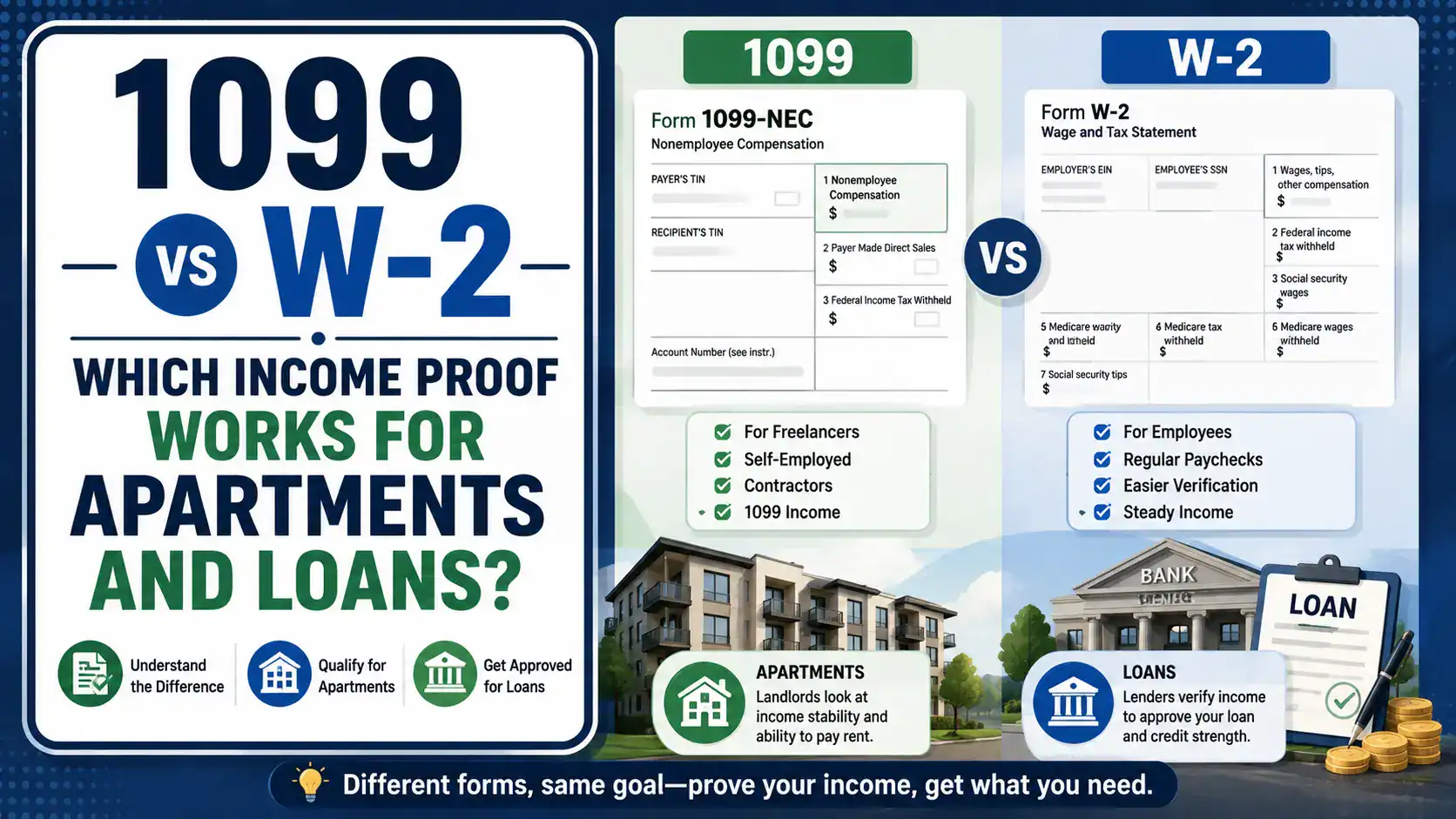
In the 1099 vs W-2 income proof comparison, a W-2 is generally seen as the stronger, more trusted document by landlords and lenders, since it’s employer-issued and already reflects withheld taxes. A 1099 works just as well, but usually needs to be paired with bank statements or a tax return, since it only shows gross payments before business expenses are factored in.
The Quick Verdict, Before We Get Into the Why
If you’re in a hurry: hand over your W-2 if you have one and it’s recent enough to matter. If you’re self-employed, freelancing, or working gig platforms, your 1099 is the right document, you just shouldn’t expect it to stand entirely on its own the way a W-2 often can.
That’s the short version. But “why” matters here, because understanding it changes how you actually put your application together, especially if your income comes from more than one source, which, if you’re reading this, it very possibly does.
Why People Get Stuck Comparing These Two
Here’s a situation that comes up constantly: someone has a W-2 job during the day and drives for a rideshare app on weekends, or freelances on the side. Application time rolls around, and suddenly they’re holding two completely different documents that don’t talk to each other, wondering which one actually counts, or whether they need both.
The honest answer is that it depends on what you’re applying for, how much of your income each document represents, and whether the numbers on each one tell a complete story on their own. Let’s break both documents down properly, then get into exactly when each one wins.
1099 vs W-2: The Head-to-Head Comparison
| W-2 | 1099 | |
| Issued by | Your employer | Each client, platform, or company that paid you |
| Shows | Total taxable wages after withholding | Gross payments before any expenses |
| Taxes already withheld? | Yes | No |
| Trusted as a standalone document? | Usually, yes | Often needs a supporting document |
| Best paired with | A recent pay stub | Bank statements or a tax return |
| Reflects current income? | Not fully, it’s a full prior year | Not fully, same limitation |
Why a W-2 Usually Wins on Trust
A W-2 tends to carry more weight on its own for a simple reason: it comes from your employer, taxes have already been withheld, and the number on it is what you actually take home minus what’s already been paid to the government. There’s very little left to interpret. A landlord or lender can look at the figure and reasonably trust that it represents real, after-withholding earnings.
The tradeoff is that a W-2 only comes out once a year, so it’s always somewhat behind. If you got a raise in March, your last W-2 won’t show it. That’s exactly why W-2s usually get paired with a recent pay stub, the W-2 shows the annual trend, the pay stub shows what’s happening right now.
Why a 1099 Needs a Little More Backup
A 1099 reports gross payments a client, platform, or company made to you, before taxes, and before any business expenses are subtracted. That last part is the key difference. If you earned $80,000 in 1099 income but spent $25,000 on business expenses, your actual take-home is closer to $55,000, and the 1099 alone doesn’t show that gap.
This is exactly why landlords and lenders usually ask for something alongside a 1099, bank statements to confirm real deposits, or a tax return with Schedule C to see your net income after expenses. It’s not that a 1099 is untrustworthy; it’s just an incomplete picture without one of those companions. Our deeper guide on self-employed proof of income documents walks through exactly how to build that fuller picture.
For Apartments: Which One Actually Wins?
For a rental application, the honest answer is that it depends on how much of your income each document represents.
If you’re a full-time W-2 employee with a small side gig, lead with your W-2 and recent pay stubs, that’s your primary income, and it’ll carry the application. Mention the 1099 income as a bonus, with bank statements to back it up if it’s meaningful.
If you’re primarily 1099-based, freelancing, contracting, or gig work, your 1099 becomes the centerpiece, but plan on pairing it with 2-3 months of bank statements and, ideally, your most recent tax return. Landlords generally understand that self-employed applicants don’t walk in with a single clean document, and most are used to reviewing a small packet rather than one piece of paper. Our guide on proving income as a freelancer for an apartment goes step by step through building that packet.
For Loans: Which One Actually Wins?
Loans, especially auto loans and mortgages, tend to weight this slightly differently than apartments do. Lenders often run automated employment verification for W-2 income (through databases like The Work Number), which makes W-2-based applications move noticeably faster. Our breakdown of car loan income verification covers exactly how this automated process works and how it differs by income type.
1099 and self-employed income, on the other hand, typically requires manual underwriting, meaning a real person reviews your tax returns and bank statements rather than a system pulling data automatically. This isn’t a strike against you; it just means the process takes a bit longer and the documentation needs to be more complete upfront, usually 1-2 years of tax returns rather than a single form.
What If You Have Both W-2 and 1099 Income?
This is more common than most people expect, and it’s not a problem, it just needs to be presented as one combined picture rather than two separate, disconnected documents.
Start with whichever source represents the larger share of your income, and lead with that. Include your W-2 and recent pay stubs for the employment side, and your 1099(s) alongside bank statements or a tax return for the self-employed or gig side. A short cover note, one or two sentences explaining that you have income from both a job and freelance or gig work, helps whoever’s reviewing your application understand the full picture immediately, instead of trying to piece it together themselves.
If your combined income from both sources matters for qualifying (say, you need both to comfortably cover rent or a loan payment), it’s worth saying so explicitly rather than assuming it’s obvious. Lenders and landlords are generally willing to combine income sources, they just need to actually see both clearly documented.
A Real Example: Two People, Two Very Different 1099 vs W-2 Situations
It helps to see this play out with actual numbers. Take someone with a $65,000 W-2 salary and a $12,000 side gig reported on a 1099. Here, the W-2 is doing almost all the heavy lifting, it should lead the application, with the 1099 and a couple of bank statements included as supporting evidence of extra income, not as the main event.
Now flip it: someone earning $70,000 through 1099 freelance work with no W-2 job at all. In this case, the 1099 vs W-2 comparison isn’t really a comparison anymore, since there’s no W-2 to weigh it against. The 1099 becomes the anchor document, and it needs real support, a tax return showing net income after expenses, plus 3-6 months of bank statements confirming the deposits actually happened. Treating a 1099 like a self-sufficient W-2 replacement in this scenario is the most common mistake freelancers make, and it’s exactly why applications stall when a 1099 shows up alone with nothing backing it up.
Frequently Asked Questions
Is a W-2 or 1099 better for proof of income?
A W-2 is generally considered stronger as a standalone document since it’s employer-issued and already reflects tax withholding. A 1099 works just as well but is usually paired with bank statements or a tax return, since it only shows gross payments before business expenses are subtracted.
Can I use a 1099 as proof of income for an apartment?
Yes. A 1099 is widely accepted as proof of income for renters, especially freelancers, contractors, and gig workers. Most landlords will also ask for supporting documents like bank statements or a recent tax return, since a 1099 alone doesn’t show your net income after business expenses.
Do lenders prefer W-2 or 1099 income for loans?
Lenders often process W-2 income faster since it can be verified automatically through employment databases. 1099 and self-employed income typically requires manual underwriting, involving a review of tax returns and bank statements, which generally takes longer but is just as acceptable for approval.
What if I have both W-2 and 1099 income?
Combine both into one application packet rather than submitting them separately. Lead with whichever income source is larger, include supporting documents for each (pay stubs for W-2, bank statements or a tax return for 1099), and consider adding a short note explaining your combined income situation.
Why does a 1099 need extra documents but a W-2 doesn’t?
A W-2 already reflects tax withholding and comes directly from an employer, making it a fairly complete picture on its own. A 1099 shows gross payments before any business expenses are deducted, so bank statements or a tax return are typically needed to show your actual net income.
Is a 1099 as legitimate as a W-2 for income verification?
Yes, a 1099 is just as legitimate and widely accepted. The difference isn’t about legitimacy, it’s that a 1099 alone doesn’t account for business expenses, so it’s typically most effective when paired with one additional supporting document.
The Bottom Line
In the 1099 vs W-2 comparison, neither document is “better” in an absolute sense, they just tell different amounts of the story on their own. A W-2 tends to stand alone more easily because taxes are already withheld and there’s an employer behind it. A 1099 is equally valid, but it usually needs a bank statement or tax return standing next to it to show the full picture.
If your income comes from a mix of both, present them together as one combined case rather than two separate pieces. And whichever type of income you’re working with, our W2/1099 page can help you put together accurate, ready-to-submit documentation.

Add comment