
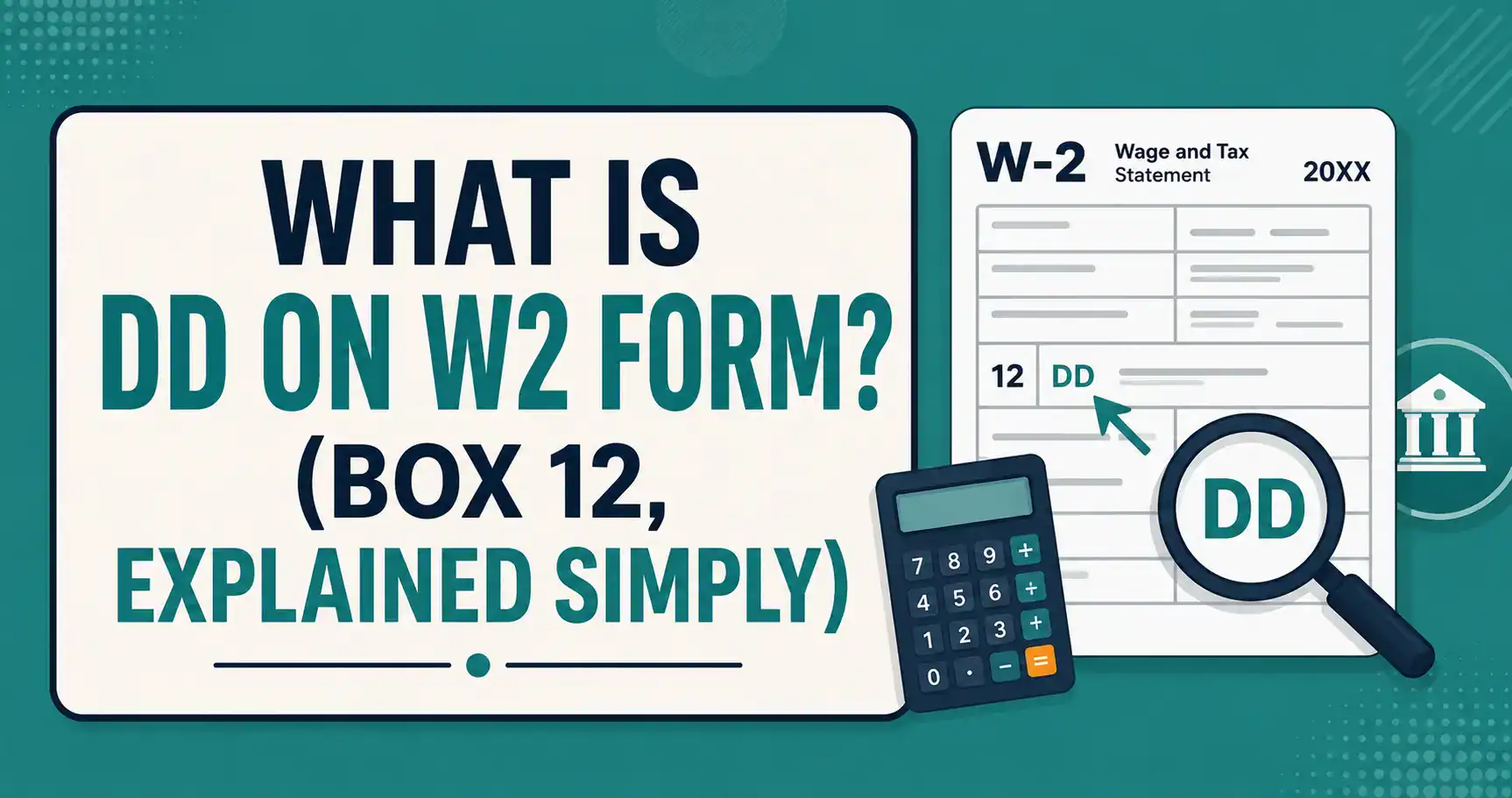
Quick Answer: What is DD on W2 form? Code DD in Box 12 shows the total cost of your employer-sponsored health insurance for the year, both what you paid and what your employer paid combined. It’s for informational purposes only. It’s not taxable, and it doesn’t change your refund or what you owe.
Why This Number Freaks People Out Every Tax Season
You’re looking over your W-2, and there it is, Box 12, code DD, and a number that’s way bigger than you expected. Maybe it’s $8,000. Maybe it’s more. Your first thought is probably something like: “Wait, do I owe tax on this? Did I miss something on my paycheck all year?”
Take a breath. You didn’t miss anything, and no, you don’t owe tax on it. Code DD is one of the most commonly misunderstood numbers on the entire W-2, mostly because it’s large and sits right next to boxes that genuinely do affect your taxes. It doesn’t help that most explanations of it online read like they were copied straight out of an IRS manual, technically correct, but not exactly written for someone squinting at their W-2 at 11pm wondering if they’re about to owe money they don’t have.
So let’s actually walk through it properly. What it is, why it’s there, why the number always looks bigger than you expect, and, most importantly, why none of it changes what you owe or get back this year.
What Is DD on W2 Form, Exactly?
DD is a code the IRS uses inside Box 12 of your W-2 to report the total cost of your employer-sponsored health coverage for the year. That figure includes two things added together: the portion of your health insurance premiums that you paid through payroll deductions, and the portion your employer paid on your behalf.
Here’s a way to picture it. Say your paycheck shows $150 a month coming out for health insurance. You’ve probably done the mental math on that number a dozen times, $150 times 12 is $1,800 a year, easy. Then you look at Box 12, code DD, and it says $7,800. Suddenly your calculator feels wrong.
It isn’t. Your employer has been quietly paying roughly $500 a month on top of your $150, and you likely never saw that number anywhere, because it never touched your paycheck. Add $150 and $500 together, multiply by 12, and you land right around $7,800. That’s the whole mystery, solved in one sentence: the number you’re used to is only ever your slice of it.
Why Is This Even on My W-2?
This isn’t your employer being nosy about your health plan, it’s a legal requirement, and one that goes back further than most people realize. Under the Affordable Care Act, signed into law in 2010, employers became required to report the total cost of employer-sponsored health coverage on employees’ W-2 forms, and Box 12 with code DD is where that number lives.
The purpose is purely informational. Lawmakers wanted a way to track how much health coverage actually costs across the country, without creating a new tax on it. That’s an important distinction, this requirement exists to measure something, not to tax something. Some very small employers, generally those filing fewer than 250 W-2 forms, are still exempt from this specific reporting rule, which is why not everyone sees a code DD entry on their W-2 even today, more than a decade after the law took effect.
Does Code DD Affect My Taxes or Refund?
No. This is the single most important thing to know about Box 12 code DD: the amount is not included in your taxable wages, it’s not added to your income anywhere on your tax return, and it has zero effect on your refund or what you owe.
You don’t need to enter it anywhere special when filing, and most tax software (TurboTax, H&R Block, and others) simply carries it over from your W-2 without doing anything with it, precisely because it isn’t meant to change your tax calculation at all. If you’re filing on your own and see a field for Box 12 codes, you can enter DD and the amount exactly as shown, it just won’t move any numbers on your return.
Box 12 Code DD vs. Other Common W-2 Codes
Box 12 has a whole alphabet of codes, and DD often gets confused with a few others that sit nearby. Here’s how they compare.
| Code | What It Represents | Affects Your Taxes? |
| DD | Total cost of employer-sponsored health coverage (employee + employer) | No, informational only |
| D | Elective deferrals to a 401(k) retirement plan | Yes, reduces taxable wages |
| W | Combined employer and employee contributions to an HSA | Yes, may need to be reported on Form 8889 |
| DQ | Deferrals under a nonqualified deferred compensation plan (state/local government) | Yes, reporting may be required |
| C | Cost of group-term life insurance over $50,000 | Yes, may be included in taxable wages |
The one people mix up most often is DD versus W. Code DD is about health insurance premiums and never affects your taxes. Code W is about HSA contributions, and those do have tax implications, since HSA contributions and withdrawals follow their own separate reporting rules on Form 8889.
What If the Number Looks Wrong?
Sometimes people assume there’s a mistake because the code DD figure seems unusually high or doesn’t match what they remember paying. A few things typically explain this:
It includes your employer’s contribution, not just yours. As covered above, this is almost always the reason the number looks larger than expected, you’re only used to seeing your own payroll deduction, not the combined total.
It covers the full calendar year, including any plan changes. If you switched plans, had a raise that changed your premium, or added a dependent partway through the year, the total reflects all of that combined, which can make it harder to eyeball against a single pay stub.
It’s genuinely a payroll error. This does happen occasionally, particularly if you changed jobs, had a mid-year benefits change, or your employer switched payroll providers. If the number seems significantly out of line with your actual coverage, it’s worth asking your HR or payroll department directly rather than guessing, since they can pull the exact calculation behind the figure.
Since code DD has no impact on your tax return either way, a discrepancy here isn’t something to panic about from a filing standpoint, but it’s still worth flagging to your employer for your own records, especially if you’re also using your W-2 to verify income for something like a loan or rental application.
The Silver Lining Nobody Mentions: What This Number Actually Tells You
Here’s something worth sitting with for a second, because almost nobody frames it this way: code DD is one of the only places on your entire W-2 where you can see, in black and white, exactly how much your employer is spending on you beyond your paycheck.
Most people think of their salary as their whole compensation. Code DD is a quiet reminder that it isn’t. If that number says $7,800, your employer effectively handed you an additional $7,800 in value this year that never touched your bank account and never got taxed, which, depending on your tax bracket, is arguably worth more than the same amount in salary would have been. It’s not a bad thing to glance at once a year, especially if you’re ever comparing job offers and trying to figure out which one actually pays better once benefits are factored in. A slightly lower salary with a much higher code DD number can genuinely be the better deal.
What If You’re Self-Employed or a 1099 Contractor?
If you’re self-employed, a freelancer, or you work as a 1099 contractor, you won’t see a code DD entry anywhere, for a simple reason, there’s no W-2 in the picture at all. This box only exists because an employer is reporting employer-sponsored coverage, and self-employed individuals don’t have an employer paying part of their health insurance through payroll.
That doesn’t mean self-employed health insurance costs disappear from your taxes altogether, they’re just handled in a completely different place, typically as a self-employed health insurance deduction on your tax return, rather than an informational line on a W-2. If you’re comparing notes with a friend who’s a W-2 employee and wondering why their tax documents look nothing like yours, this is usually the reason. Our guide on proof of income documents for every situation breaks down how W-2s, 1099s, and other income records differ depending on how you’re employed, which is worth a look if this is the first time you’re comparing the two side by side.
Where Exactly to Find It on Your W-2
Box 12 on a W-2 isn’t just one line, it actually has room for up to four separate code-and-amount entries, labeled 12a, 12b, 12c, and 12d. Code DD could show up in any of these four slots, not necessarily always “12a” or always in the same position from year to year, which is part of why people sometimes struggle to spot it.
Look for a single letter box containing “DD,” followed immediately by a dollar amount in the box next to it. If you have multiple entries in Box 12, for example, a retirement contribution under code D and health coverage under code DD, they’ll simply be listed one after another in whichever of the four lettered slots they were entered into. The letter code is what tells you what the number means, not its position in the box.
A Bit of Background: Why This Rule Exists
This reporting requirement traces back to the Affordable Care Act, which was signed into law in 2010. Originally, the requirement to report health coverage costs on the W-2 was meant to take effect almost immediately, but the IRS granted transition relief to many employers, which delayed mandatory reporting for smaller organizations for several years while payroll systems caught up.
Today, most employers with 250 or more W-2 forms in the prior year are required to include this figure, while many smaller employers still aren’t. That’s the main reason two people working similar jobs at different-sized companies might have very different experiences, one seeing a code DD entry every year, and the other never seeing one at all.
Need help understanding your W-2 or putting together income documentation? Our w2 Tax form guide covers exactly what W-2s, pay stubs, and other income records are used for, help if you need accurate documentation built from your real numbers.
Frequently Asked Questions
What is DD on W2 form?
DD is a code in Box 12 of your W-2 that reports the total cost of your employer-sponsored health insurance coverage for the year, including both your contributions and your employer’s. It’s required under the Affordable Care Act and is for informational purposes only.
Does code DD on my W2 affect my tax refund?
No. The amount listed under code DD is not taxable income and isn’t included anywhere in your tax calculation. It has no effect on your refund or the amount you owe, regardless of how large the number appears.
Why is the code DD amount on my W2 so high?
The code DD amount includes both your payroll deduction and your employer’s contribution toward your health insurance combined, which is usually much higher than what you see coming out of your own paycheck. It also reflects the full year, including any changes to your plan or coverage.
What’s the difference between code DD and code W on a W2?
Code DD reports the total cost of employer-sponsored health insurance and never affects your taxes. Code W reports combined employer and employee contributions to a Health Savings Account (HSA), which does have tax implications and is reported separately on Form 8889.
Do I need to report code DD anywhere on my tax return?
No. You don’t need to take any special action with the code DD amount. If your tax software asks for Box 12 codes, you can enter it as shown on your W-2, but it won’t change your taxable income, your refund, or the amount you owe.
What if my W-2 doesn’t have a code DD entry at all?
Not every employer is required to report this. Employers that filed fewer than 250 W-2 forms in the prior year are generally exempt from this specific reporting requirement, so a missing code DD entry doesn’t necessarily mean anything is wrong with your W-2.
The Bottom Line
So, next tax season, when you spot code DD sitting there with a number that looks bigger than your entire monthly rent, you’ll know exactly what it is: the full cost of your health coverage, your contribution and your employer’s added together, required by law, and completely harmless to your tax return. Nothing to enter, nothing to calculate, nothing to owe because of it.
If a number on your own W-2 still doesn’t sit right after reading this, maybe it’s way higher than it should be, or you switched jobs mid-year and the math looks off, your HR or payroll team can walk you through exactly how it was calculated, and it’s worth the two-minute email just for your own peace of mind. And if you’re pulling your W-2 alongside other paperwork to verify income for a loan, an apartment, or anything similar, our proof of income documents guide breaks down exactly what’s typically expected for situations like that.
This article reflects 2026 IRS Form W-2 reporting requirements under the Affordable Care Act. It is not tax advice. For questions about your specific tax situation, contact us. We update this guide regularly to reflect current standards.





Add comment