
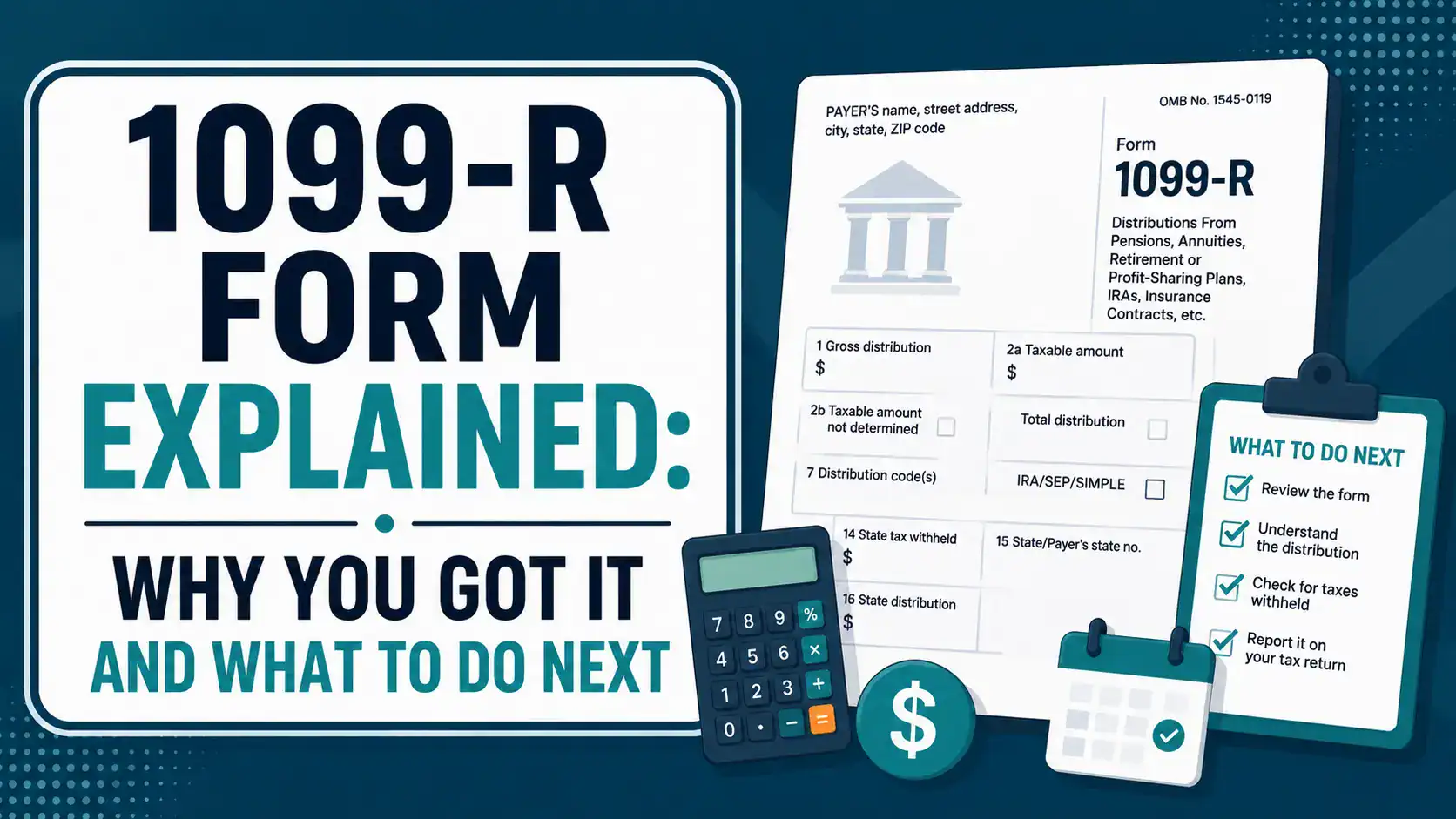
Every January, retirement account holders across the country open their mailbox or online portal and find a form they didn’t ask for and don’t fully understand, the 1099-R. Maybe you took a distribution from your 401(k), rolled over an IRA, or started drawing your pension for the first time. Whatever the reason, this little form now has to make its way onto your tax return, and getting it wrong can mean an unwanted letter from the IRS later.
This guide breaks the 1099-R form down in plain language: what it is, why you got it, what each part means, and how to use it correctly when you file. No jargon, no guessing, just what you actually need to know.
What Is a 1099-R Form?
A 1099-R form is an IRS information return used to report distributions of $10 or more from pensions, annuities, retirement plans, profit-sharing plans, IRAs, insurance contracts, and similar accounts. Whoever manages the account, a 401(k) administrator, an IRA custodian, an insurance company, or a pension fund, is required to send you a copy and file one with the IRS as well.
Put simply: any time money moves out of a retirement-type account, whether you asked for it, it happened automatically, or it resulted from a loan default, there’s a good chance a 1099-R gets generated to document it.
It’s easy to assume this form only applies to retirees, but that’s not quite accurate. Plenty of people still working receive a 1099-R too, for example, if they took a hardship withdrawal, rolled funds between accounts, or defaulted on a retirement plan loan.
What Is Form 1099-R Used For?
At its core, a 1099-R exists so the IRS can match what you report on your tax return against what a financial institution says it paid you. Specifically, it’s used to:
- Report the total (gross) amount distributed from a retirement account during the year
- Show how much of that distribution is actually taxable
- Record any federal or state tax already withheld from the distribution
- Flag the type of distribution using a code, so the IRS and you both know whether it was normal, early, a rollover, or something else
- Help you determine whether an early withdrawal penalty applies
Without this form, there’d be no consistent paper trail connecting the money that left your retirement account to the income you’re supposed to declare.
Who Sends You a 1099-R?
You’ll typically receive a 1099-R form from:
- Your employer’s pension plan administrator
- The custodian holding your traditional or Roth IRA
- An insurance company managing an annuity or life insurance contract with a cash distribution
- A 401(k) or 403(b) plan provider
- A government retirement system, including certain state and local plans
By law, these institutions must send you the form by January 31, and file it with the IRS by the end of February on paper, or by March 31 if filed electronically.
Breaking Down the Boxes on Form 1099-R
Here’s where a lot of confusion comes from, the form has more than a dozen boxes, and not every one applies to every situation. The table below covers the ones that matter most.
| Box | What It Reports |
| Box 1 | Gross distribution, the total amount paid out before any deductions |
| Box 2a | Taxable amount, the portion of the distribution that’s subject to income tax |
| Box 4 | Federal income tax withheld from the distribution |
| Box 5 | Employee contributions, insurance premiums, or after-tax amounts (often not taxable again) |
| Box 7 | Distribution code, a number or letter indicating the type of distribution |
| Box 14–17 | State tax withheld and related state distribution information |
Box 7 is usually the one people get stuck on, since it’s a short code that carries a lot of meaning.
Understanding 1099-R Distribution Codes
The distribution code in Box 7 tells you (and the IRS) exactly what kind of payout you received. A few of the most common ones:
- Code 1 – Early distribution, no known exception (usually means an early withdrawal penalty applies)
- Code 2 – Early distribution, but an exception applies, so the penalty is waived
- Code 3 – Distribution due to disability
- Code 4 – Distribution due to death of the account holder
- Code 7 – Normal distribution, meaning the account holder was already 59½ or older
- Code G – Direct rollover to another qualified plan or IRA
- Code J – Early distribution from a Roth IRA
If your form shows a 1099-R distribution code 7, that simply means it was a normal, penalty-free distribution taken at or after retirement age, nothing unusual, and no early withdrawal penalty applies.
Where to Report 1099-R on Form 1040
Once you have your 1099-R in hand, the numbers generally flow onto your Form 1040 as follows:
- The gross distribution from Box 1 goes on the pensions and annuities line of your 1040
- The taxable amount from Box 2a goes on the corresponding taxable amount line right next to it
- If federal tax was withheld in Box 4, that amount gets included with your total withholding, which reduces what you owe (or increases your refund)
- If the distribution was fully rolled over into another qualified account, you’d generally report the gross amount but write “Rollover” next to the taxable amount line, since a properly completed rollover usually isn’t taxed
Because software and paper forms occasionally shift line numbers year to year, it’s worth double-checking the current year’s 1040 instructions or having someone verify it for you, especially if your 1099-R involves a rollover, a loan default, or multiple distribution codes.
Is 1099-R Taxable Income?
This depends entirely on the type of distribution. Some situations are fully taxable, some are partially taxable, and some aren’t taxable at all:
- Traditional 401(k)/IRA distributions are generally fully taxable, since the money went in pre-tax
- Roth IRA qualified distributions are typically tax-free, since contributions were already taxed going in
- Distributions that include after-tax contributions may only be partially taxable, with Box 5 showing the non-taxable portion
- Properly executed rollovers aren’t taxed at all, as long as the funds moved into another qualified account within the allowed timeframe
- Early distributions without an exception are taxable and may also carry a 10% early withdrawal penalty
Box 2a is usually your best starting point for figuring out the taxable amount, but it’s not always filled in accurately by the payer, especially with older accounts, so it’s worth confirming the number makes sense given your contribution history.
How to Get a Copy of Your 1099 Online
If your form never arrived, or you misplaced it, most plan administrators, banks, and insurance companies now offer digital copies. A few ways to track it down:
- Log into your retirement account’s online portal (401(k) provider, IRA custodian, or pension system) and look for a tax documents or statements section
- Check for an email notification from your plan administrator around late January, which often links directly to the downloadable form
- Contact the payer’s customer service line directly if you can’t locate it online
- As a last resort, you can request a wage and income transcript from the IRS, which will show what 1099-Rs were filed under your Social Security number
Common Mistakes People Make With Form 1099-R
A few recurring issues to watch out for:
- Reporting the gross amount (Box 1) as taxable income instead of the actual taxable amount in Box 2a
- Forgetting to note a rollover, which can cause the entire distribution to look taxable when it isn’t
- Overlooking state withholding shown in Boxes 14–17, especially if you moved states during the year
- Assuming every early distribution automatically carries a penalty, without checking if an exception code applies
- Filing before checking for a corrected 1099-R, which payers sometimes issue after an initial reporting error
Getting Help With Your 1099-R Form
Retirement distributions rarely come with a simple answer, especially once rollovers, partial withdrawals, or multiple accounts get involved. If you’re trying to figure out where a specific box on your 1099-R belongs on your return, or you need help organizing your tax documents before filing, financialdocsprovider Tax Documents can help you sort through it properly. Click here if you’d like assistance reviewing your 1099-R and putting together an accurate, penalty-free tax filing.
Frequently Asked Questions
What is a 1099-R form used for?
It’s used to report distributions of $10 or more from retirement accounts, pensions, annuities, and similar plans, so both you and the IRS have a matching record of the payout.
What is form 1099-R if I rolled my funds into another account?
It still gets issued to document the total amount that moved, even if the rollover itself isn’t taxable, you just note it as a rollover when filing.
What is a 1099-R form distribution code 7?
It indicates a normal distribution, meaning it was taken after the account holder reached the standard retirement age with no penalty involved.
Where do I report 1099-R on my 1040?
The gross distribution and taxable amount are entered on the pensions and annuities section of your Form 1040, with any withholding added to your total tax payments.
How can I get a copy of my 1099-R online?
Log into your plan provider’s portal, check for an emailed notification, or request an IRS wage and income transcript if the original copy can’t be located.
Final Thoughts
A 1099-R form isn’t as complicated as it first looks once you know what each box represents and what the distribution code actually means. Whether you’re dealing with a straightforward normal distribution or something more involved like a partial rollover or an early withdrawal, the key is matching the right numbers to the right lines on your return.
If you’d rather have a professional pair of eyes on it, financialdocsprovider is ready to help, click through anytime you’d like support getting your 1099-R and the rest of your tax documents filed correctly.




Add comment