
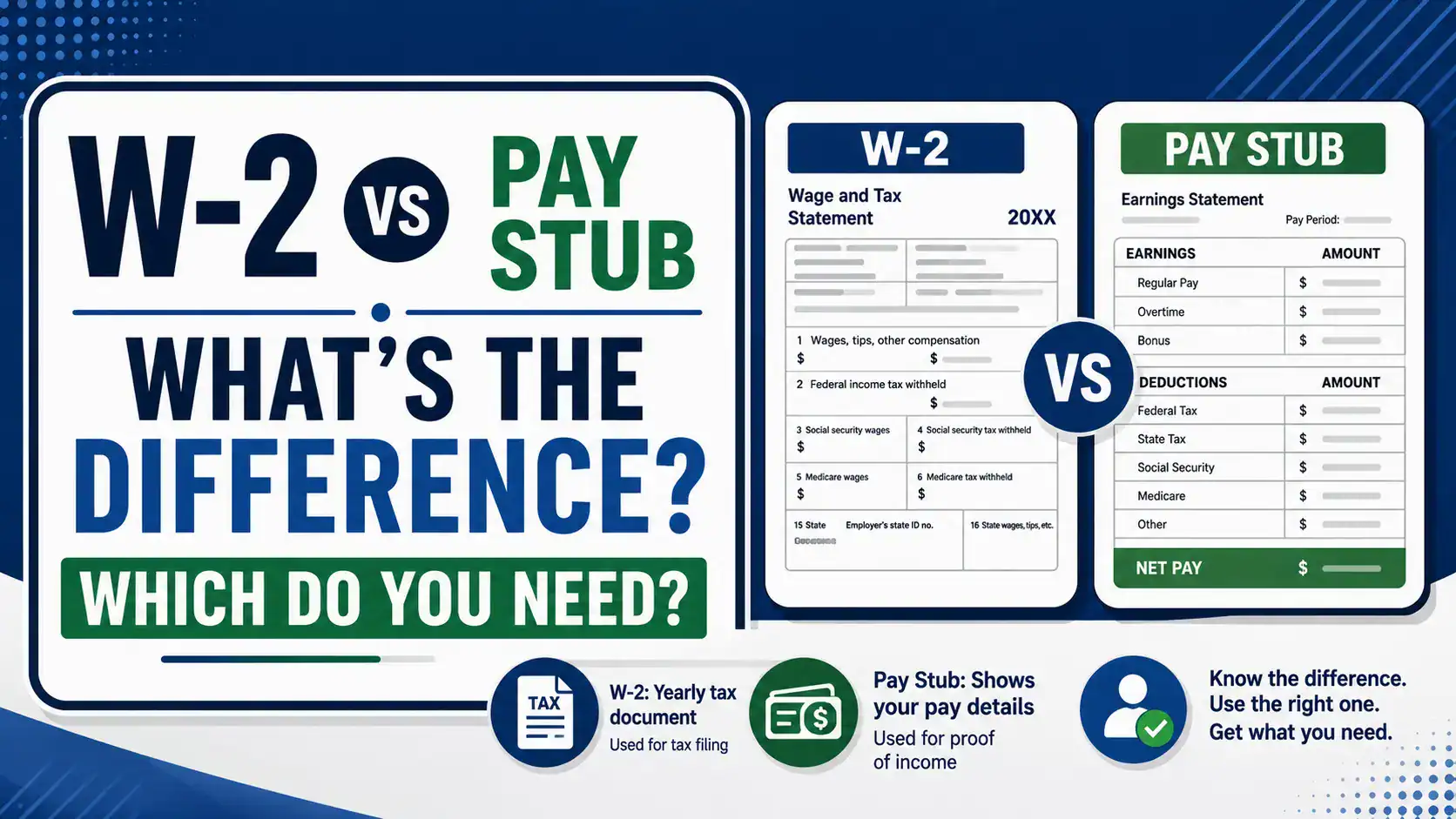
The W-2 vs pay stub difference comes down to this: a pay stub is issued every payday and shows your gross pay, deductions, and net pay for that specific period, while a W-2 is an annual IRS tax form summarizing your total taxable wages and withholding for the full year. Which one you actually need depends on the situation, tax filing requires a W-2, while proving current income to a landlord or lender usually calls for recent pay stubs instead.
Why Doesn’t My W-2 Match My Last Pay Stub?
Every January, the same confused message shows up in payroll inboxes everywhere: “My final pay stub said I earned $61,000 this year, but my W-2 says $53,000. Did my employer make a mistake?” Almost always, the answer is no, nothing went wrong, and this is actually completely normal.
The confusion makes sense, though. Both documents come from the same paycheck, the same employer, and roughly the same period, so it feels like they should show identical numbers. They don’t, and once you understand the W-2 vs pay stub difference, the gap between the two numbers stops being a mystery and starts making a lot more sense.
This guide covers exactly what separates a pay stub from a W-2, why the dollar amounts on each rarely match, and, just as importantl, which one you should actually be reaching for depending on what you’re trying to do.
What Is a Pay Stub?
A pay stub is a per-paycheck record your employer generates every time you get paid, whether that’s weekly, biweekly, or monthly. It shows your gross pay for that period, a breakdown of deductions (taxes, benefits, retirement contributions), your net pay, and usually a running year-to-date total for each of those categories. It’s an operational document, generated by payroll software, and it’s not filed with the IRS.
What Is a W-2?
A W-2, officially called the “Wage and Tax Statement,” is an annual tax form your employer is required to send you by January 31 each year. It summarizes your total taxable wages and total tax withholding for the entire previous calendar year, and it’s sent not just to you, but to the IRS and the Social Security Administration as well. Unlike a pay stub, a W-2 is a formal tax document with legal reporting requirements attached to it.
Why the Numbers Never Quite Match: The Real W-2 vs Pay Stub Difference
Here’s the part that trips almost everyone up. Your final pay stub of the year typically shows your gross earnings, the full amount you were paid before anything was taken out. Your W-2, on the other hand, shows your taxable wages, which is usually a smaller number, because it’s calculated after certain pre-tax deductions have already been subtracted.
A few things commonly explain the gap:
Pre-tax retirement contributions. Money you put into a 401(k) or similar plan reduces your taxable wages in Box 1 of your W-2, even though it still shows up as part of your gross pay on your pay stub.
Pre-tax health insurance premiums. Contributions toward health, dental, or vision coverage are usually deducted before taxes are calculated, which lowers your W-2 taxable wages without changing what your pay stub shows as gross earnings.
Non-taxable reimbursements. Things like mileage reimbursement or certain work-related expense payments show up in your gross pay but aren’t considered taxable income, so they’re excluded from your W-2 entirely.
Put simply: your pay stub is showing you everything that came through your paycheck, while your W-2 is showing the government only the portion of it that’s actually taxable. Neither number is wrong, they’re just answering different questions.
W-2 vs Pay Stub: When Do You Actually Need Which One?
This is the part most explanations skip entirely, and it’s arguably the most useful thing to actually know. Depending on what you’re doing, one of these documents is almost always the better (or only) option.
Filing your taxes. You need your W-2, not your pay stub. The IRS requires the official W-2 for tax filing, and using your last pay stub instead can lead to filing with inaccurate numbers, since it doesn’t reflect your actual taxable wages.
Applying for an apartment or a loan. Recent pay stubs are usually what’s requested here, typically your last 2-3, since landlords and lenders want to see current, ongoing income rather than a once-a-year snapshot. A W-2 only comes out annually, so it can’t show what you’re earning right now if your income or job has changed recently.
Proving current employment. A recent pay stub does this better than a W-2, since it shows an active, recent pay period rather than a historical annual summary.
Verifying a full year of income for something like a mortgage. Lenders often want both, your W-2 for the official annual figure, and recent pay stubs to confirm your income is still consistent with what the W-2 showed.
Disputing a paycheck error. Your pay stub is the right document here, since it breaks down the specific pay period in question, while a W-2 only shows an annual total and won’t help identify a single-period discrepancy.
Applying for unemployment benefits. This varies by state, but many unemployment offices want recent pay stubs to verify your most recent earnings and employment status, rather than an annual W-2.
If you’re ever unsure which one a specific request actually needs, our broader guide on proof of income documents for every situation breaks down exactly what’s expected across rentals, loans, and other common scenarios.
W-2 vs Pay Stub: Quick Comparison Table
| Feature | Pay Stub | W-2 |
| Issued | Every pay period | Once a year, by January 31 |
| Shows | Gross pay, deductions, net pay for that period | Total annual taxable wages and withholding |
| Filed with the IRS? | No | Yes |
| Best for | Proving current income, employment, or resolving paycheck disputes | Filing taxes, official annual income records |
| Generated by | Payroll software | Employer’s payroll/HR system, per IRS requirements |
A Few Related Confusions Worth Clearing Up
If you’ve spent any time comparing your W-2 to your pay stub, a couple of related questions tend to come up right alongside it.
One common one: what does that unusually large number next to code DD in Box 12 mean, and does it affect any of this? It doesn’t. Box 12 code DD reports the cost of your employer-sponsored health coverage, and it’s informational only, with zero effect on your taxable wages or your refund.
Another common source of confusion is the pressure some people feel to make their income documents look “better” for a loan or rental application, especially when a pay stub and W-2 don’t match perfectly. It’s worth knowing that submitting an altered version of either document is treated as federal fraud, our guide on why fake W-2s and pay stubs get caught in 2026 covers this in detail, along with the legitimate alternatives that work just as well without any of the risk.
Need help putting together accurate income documentation? Our proof of income template helps employees, freelancers, and self-employed individuals create legitimate, accurate pay stubs and income verification letters.
Frequently Asked Questions
What is the difference between a W-2 and a pay stub?
A pay stub is issued every pay period and shows your gross pay, deductions, and net pay for that specific period. A W-2 is an annual IRS tax form summarizing your total taxable wages and withholding for the entire year. A pay stub is an operational payroll document, while a W-2 is an official tax record filed with the IRS.
Why is my W-2 lower than my last pay stub?
Your W-2 typically shows a lower number than your final pay stub because it reflects taxable wages after pre-tax deductions like 401(k) contributions and health insurance premiums, while your pay stub shows your full gross pay before those deductions are factored out.
Can I use my last pay stub instead of a W-2 to file taxes?
No. The IRS requires your official W-2 for tax filing, since it reflects your accurate taxable wages and withholding. Using your last pay stub instead can result in filing with incorrect numbers, which may require you to amend your return later.
Which document do I need to apply for an apartment: a W-2 or pay stubs?
Most landlords want recent pay stubs, typically your last 2-3, since they show current, ongoing income. A W-2 only reflects a full prior year and won’t show recent income changes, which is why pay stubs are generally preferred for rental applications.
Do I need a W-2 or pay stub to prove employment?
A recent pay stub is generally the better document for proving current employment, since it reflects an active, recent pay period. A W-2 shows an annual summary and doesn’t confirm that you’re still currently employed.
When would I need both my W-2 and my pay stubs?
Mortgage lenders and some larger loan applications often want both, your W-2 for an official annual income record, and recent pay stubs to confirm your income is still consistent with what the W-2 reported, especially if some time has passed since the W-2 was issued.
The Bottom Line
The W-2 vs pay stub difference really comes down to timing and purpose: a pay stub is a per-paycheck snapshot generated by payroll, while a W-2 is an official annual tax record required by the IRS. Neither one is more “correct” than the other, they’re simply built to answer different questions, which is exactly why the numbers on each rarely match.
Knowing which one a specific situation actually calls for saves you from submitting the wrong document, or worse, assuming something’s gone wrong when it hasn’t. If you need help creating accurate pay stubs or income documentation, our proof of income template can help you get it right the first time.




Add comment